
A place to refer patients for safe deprescribing
Outro Health provides clinician-supervised tapering built on the latest guidelines. Our psychiatric clinicians take on the prescription, manage withdrawal with hyperbolic dose reductions, and stay with your patient throughout the tapering journey.

Antidepressant deprescribing is a specialty of its own
Most long-term antidepressant users experience meaningful withdrawal symptoms when they try to stop. Minimizing withdrawal takes slow, individualized reductions, at doses smaller than standard tablets allow, and monitoring between visits. That's infrastructure few practices are set up to provide.
PCPs, psychiatrists, and therapists refer to Outro Health when a patient is considering stopping their antidepressant. Our psychiatric clinicians take on the prescription and manage the taper from first reduction to last.


Primary care referrals
Your patient wants off a long-term antidepressant, and a safe taper needs more visits and dose precision than a primary care panel allows.

Psychiatrist referrals
When your patient needs the precision of compounded drugs, and between-visit monitoring for the low-dose stretch where withdrawal risk peaks.

Therapist referrals
Your client is ready to work on life beyond medication and needs a clinician trained in deprescribing, to manage the medical side of the taper.
Hyperbolic tapering uses science to help minimize withdrawal
Antidepressants block the serotonin transporter (SERT). But the relationship between dose and SERT occupancy isn’t linear—it’s hyperbolic. Occupancy climbs steeply at low doses, then flattens. Halving a 20 mg dose barely moves it; the same cut near zero falls off a cliff.
How referrals work
Referring takes a few minutes. We handle scheduling, evaluation, and the taper itself, and your patient remains in your care for everything else.
Send the referral
Share your patient's details through our referral form, or send them our way directly. We take it from there.

We evaluate
A 45-minute evaluation covers medication history, past taper attempts, and eligibility, then maps the taper plan.

You stay in the loop
We manage the prescription and the taper. We'll keep you informed of your patient's progress and coordinate with you as much as helpful.
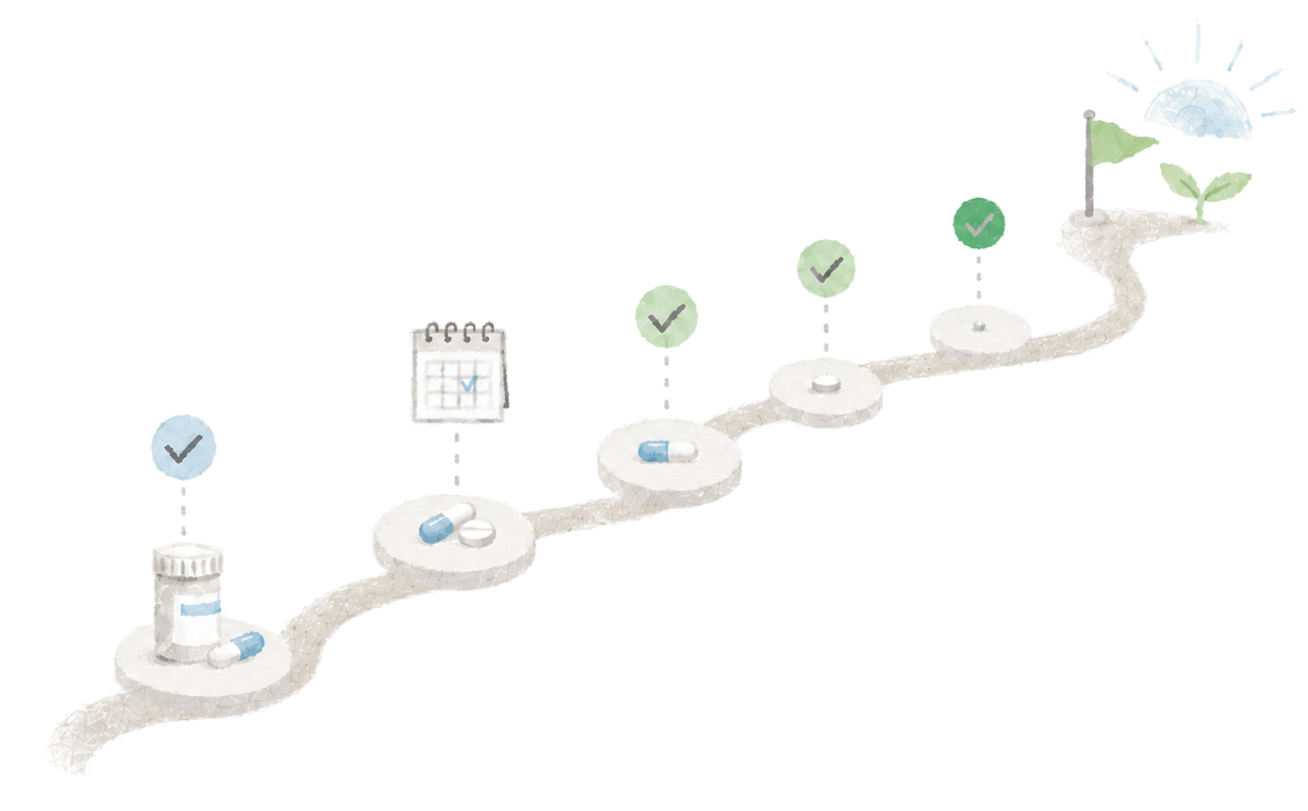
What happens after you refer
Your patient meets a psychiatric clinician trained in deprescribing by world-leading experts. Together they build an individualized hyperbolic taper plan around their medication, dose, and history, adjusted in real time based on how they actually feel.
A 45-minute evaluation screens for eligibility and maps the taper before any dose changes.
We take on prescribing for the medication being tapered, including any compounded prescriptions needed.
Reductions follow the hyperbolic curve and adjust to symptoms, rather than a fixed timeline.
Between-visit messaging and symptom monitoring, so nothing waits for the next appointment.
Antidepressant withdrawal is real, common, and underrecognized
50M
5 years
9/10
Clinicians trained by world-leading experts
In 2019, a paper in Lancet Psychiatry reframed how the field understood tapering. Five years later, that evidence became The Maudsley Deprescribing Guidelines, the first formal clinical guidelines dedicated to safely stopping antidepressants, benzodiazepines and gabapentinoids.
Dr. Mark Horowitz, MBBS, PhD, co-founder of Outro Health, is a training psychiatrist and clinical researcher, and the lead author of The Maudsley Deprescribing Guidelines.

A method backed by international organizations
The need for careful, individualized tapering, and the reality of withdrawal, is increasingly recognized across clinical and academic medicine.






“I’ve been stuck on SSRI’s for 10 years, and I’ve tried to get off a dozen times. Each time, I had terrible withdrawal symptoms, including insomnia, brain zaps, and debilitating anxiety. With Outro, I was able to get off SSRIs without any of those symptoms that plagued my previous attempts. I am so grateful to the team for their work.”
The evidence base
A selection of the peer-reviewed literature underpinning the approach described above.
Horowitz MA, Taylor D. Tapering of SSRI treatment to mitigate withdrawal symptoms.
Lancet Psychiatry. 2019;6(6):538–546. doi:10.1016/S2215-0366(19)30032-X
Horowitz MA, Taylor D. The Maudsley Deprescribing Guidelines: Antidepressants, Benzodiazepines, Gabapentinoids and Z-drugs
Wiley-Blackwell; 2024.
Davies J, Read J. A systematic review into the incidence, severity and duration of antidepressant withdrawal effects.
Addict Behav. 2019;97:111–121.
Goodwin GM, et al. Emotional blunting with antidepressant treatments.
J Affect Disord. 2017;221:31–35.
Maund E, et al. Barriers and facilitators to discontinuing antidepressant use: a systematic review and thematic synthesis.
J Affect Disord. 2019.
FAQs
Explore frequently asked questions about safe antidepressant tapering, withdrawal symptoms, lifestyle strategies, and how Outro Health works.
Outro Health provides flexible, medically-supervised tapering plan with gradual dose reductions tailored just for you. Our hyperbolic tapering method, where reductions become progressively smaller, gently minimizes nervous system disruption and withdrawal discomfort. We personalize your tapering plan based on your response, preferences, and what's happening in your life.
Safe antidepressant deprescribing requires a comprehensive approach that is often difficult for an individual prescriber to provide due to the time required. It also requires up-to-date knowledge on the latest techniques in tapering antidepressants that are not yet widely taught in the United States. Think of Outro Health as a specialist in tapering.
At Outro Health, we walk with you every step of the way. Our specialized, high-touch care team takes time to get to know you and your goals, and provides an advanced, individualized approach to tapering off antidepressants informed by the latest guidance and clinical evidence. Through Outro Health’s app, your symptoms and progress are continuously monitored by your provider, who can reach out to offer coping strategies or adapt your care plan accordingly. If you have questions or concerns that arise in between appointments, your Outro Health provider is available via 1-to-1 chat.
Hyperbolic tapering (sometimes called the Horowitz-Taylor method) is based on the fact that as antidepressant dose goes up, drug action on brain cells increases, but not in equal steps. Higher dosages have less and less additional influence – a decreasing return on investment. The graph showing this is called a hyperbolic curve (goes up faster at low doses, and flatter at higher doses).
Tapering based on this method gradually reduces the drug following this natural curve, with the size of dose reduction getting smaller as the dosage gets closer to 0mg. These very low doses are difficult to make up with commonly available tablets, so compounded medications become important. To learn more, speak with an Outro Health clinician by scheduling your evaluation.
Many people have difficulties when they try to go off antidepressants. Our team of expertly trained clinicians will develop a tailored tapering program, informed by the latest scientific evidence and designed to minimize withdrawal effects - even for these people who have tried to stop before.
We currently offer taper management for antidepressant medications. You can see the full list here.
We are making preparations to expand to other psychotropic medications like benzodiazepines and gabapentinoids, which also follow the hyperbolic tapering method. You can express an interest in tapering these medications in our sign-up form.
Refer a patient for safe deprescribing
Evidence-based tapering, supervised from first reduction to last. We handle the prescription; you keep the relationship.